GEOTECHNICAL ENGINEERING
MEMPHIS
HomeSlopes & WallsRetaining wall design

Retaining Wall Design in Memphis: Geotechnical Engineering for the Bluff City

Technical studies that support your project.

LEARN MORE

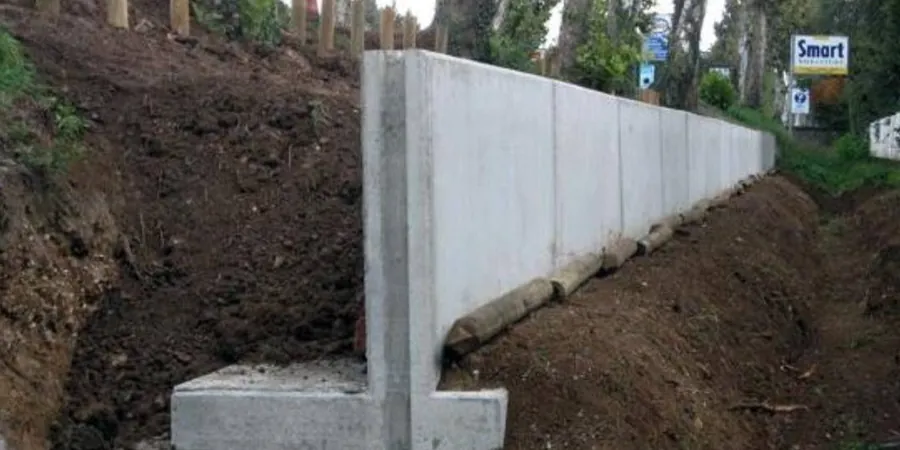
Memphis didn’t just rise on blues and cotton—it rose on a terrace of windblown silt that geotechnical engineers have been wrestling with for a century. When the city rebuilt after the yellow fever epidemics of the 1870s, builders learned quickly that the loess bluffs along the Mississippi demand more than a standard wall section. The Shelby County loess can stand near-vertical in a cut for years, then slump catastrophically after a single wet spring. Our team has worked across enough Midtown excavations and South Memphis industrial sites to know that retaining wall design here starts with reading the soil like a local. We pair subsurface data from test pits and SPT drilling with laboratory shear strength testing to build wall profiles that actually reflect the site—not just a textbook assumption.

On Memphis loess the difference between a stable wall and a lawsuit is often just five degrees of friction angle and the correct drained assumption.
Our service areas

Methodology and scope

The most frequent mistake we see on Memphis job sites is an earth pressure diagram drawn for a generic granular backfill when the retained material is actually loess-derived clay with a perched water table. That shortcut produces walls that tilt outward within two rainy seasons. A proper retaining wall design in this city has to account for the metastable structure of the loess: it carries high cohesion when dry but collapses upon saturation, shifting the lateral load regime dramatically. We run consolidated-undrained triaxial tests on Shelby Series samples to define the critical-state friction angle, then model drained and undrained conditions separately. For deeper excavations near the Wolf River floodplain, we often integrate stone columns as ground improvement beneath the wall footprint, reducing both settlement and the required section depth. Every design passes through a New Madrid seismic check using Memphis-specific site coefficients per ASCE 7-22 Chapter 11, because the 1811–1812 earthquake sequence wasn't a one-time event—it's a design condition.
Retaining Wall Design in Memphis: Geotechnical Engineering for the Bluff City
Technical reference — Memphis

Local considerations

IBC 2021 Section 1807 and ASCE 7-22 Chapter 11 put Memphis retaining walls in a category that much of the rest of the country doesn’t share: you’re designing for a short-period spectral acceleration that can exceed 1.0g on Site Class D, and loess can degrade to Site Class E under prolonged shaking. That combination—high seismic demand plus collapsible soil—means a wall failure isn’t just a serviceability problem, it’s a life-safety issue. The 2003 Memphis Light, Gas and Water seismic vulnerability study showed that even moderate New Madrid shaking would displace retaining structures along critical utility corridors. Our designs address this directly: we run pseudo-static slope stability analyses with kh coefficients scaled to the project’s risk category, and we specify backfill compaction to 95% of modified Proctor density in lifts no thicker than 8 inches. For walls over 12 feet, we require a geotechnical special inspection during construction per IBC 1705.6, something too many local projects skip until the stop-work order arrives.

Need a geotechnical assessment?

Reply within 24h.

Email: contact@geotechnical-engineering1.org

Applicable standards

ASCE 7-22 Minimum Design Loads and Associated Criteria for Buildings and Other Structures, IBC 2021 Chapter 18 Soils and Foundations / Chapter 16 Structural Design, AASHTO LRFD Bridge Design Specifications, 9th Edition, Section 11, ASTM D4767-11 Standard Test Method for Consolidated Undrained Triaxial Compression Test for Cohesive Soils, FHWA-NHI-10-024 MSE Walls and Reinforced Soil Slopes

Technical parameters

ParameterTypical value
Design standardIBC 2021 / ASCE 7-22 / AASHTO LRFD 9th Ed.
Seismic zoneNew Madrid Seismic Zone, Ss up to 1.5g (site class D/E)
Retained soil typeLoess (ML), loess-derived clay (CL), Mississippi River alluvium
Typical wall height range4 ft to 35+ ft (segmental, cantilever, anchored)
Key lab testsCU triaxial, Atterberg limits, grain-size distribution, Proctor
Drainage requirementWeep holes + gravel chimney + filter fabric per local practice
Global stability checkRequired when wall is within 2H of a slope crest or bluff edge

Frequently asked questions

What does retaining wall design cost for a typical Memphis residential lot?

For a single-family residential retaining wall in the Memphis area—typically 4 to 8 feet high and 30 to 60 linear feet—the complete geotechnical design package including subsurface exploration, laboratory testing, and stamped calculations runs between US$1,040 and US$3,830 depending on site access, required borings, and whether the wall is a simple gravity section or requires tiebacks. Walls over 10 feet or near a bluff crest fall at the upper end due to the additional global stability modeling.

How does the New Madrid seismic zone affect retaining wall design in Memphis?

The New Madrid Seismic Zone imposes horizontal ground accelerations that can be three to five times higher than what a typical building code would assume in the eastern United States. For a Memphis retaining wall, we apply a pseudo-static seismic coefficient (kh) typically between 0.05g and 0.15g depending on the project risk category, and we check the wall for both inertial effects on the structure itself and increased lateral earth pressure from the retained soil mass during shaking.

Do I need a building permit for a retaining wall in Memphis and Shelby County?

Yes. Memphis and Shelby County Code Enforcement requires a building permit for retaining walls over 4 feet in height measured from the bottom of the footing to the top of the wall, or for any wall supporting a surcharge such as a driveway or building. The permit application must include sealed geotechnical calculations and construction drawings. Walls under 4 feet without surcharge generally don’t require a permit but must still meet the code’s safety requirements.

How do Memphis loess soils behave differently from ordinary clay in wall design?

Memphis loess is a wind-deposited silt with a metastable structure: it stands on near-vertical cuts when dry but loses strength rapidly when saturated. Its collapse potential means we can’t rely on the drained cohesion intercept alone—we test for collapse strain in the laboratory and design the wall drainage system to keep the retained zone as dry as possible. We also specify compaction of the foundation subgrade to break down the loess structure where the wall footing bears, preventing differential settlement that would crack the stem.

Location and service area

We serve projects across Memphis and its metropolitan area.

View larger map