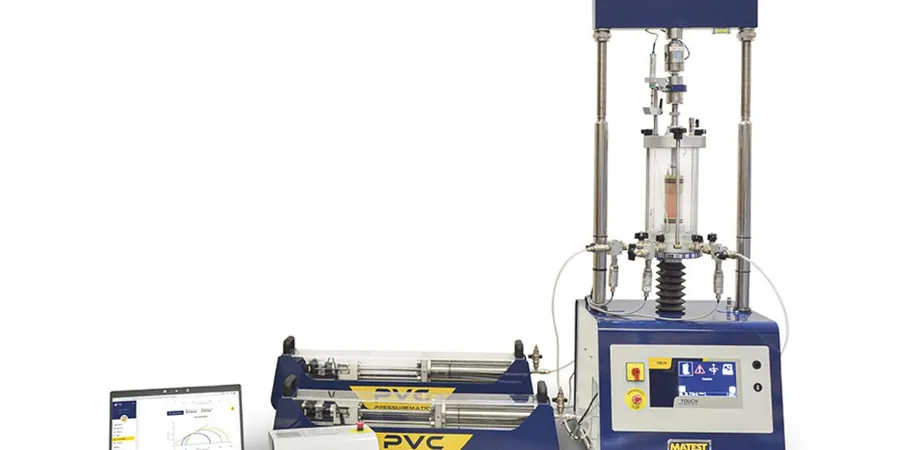
Memphis sits perched atop the New Madrid Seismic Zone, the most active earthquake region east of the Rockies. The city’s development along the Mississippi River bluffs and the Wolf River floodplain means foundation conditions vary wildly in a single block. A standard penetration test gives an index, but for critical infrastructure—like the I-40 bridge approaches or the massive FedEx World Hub—engineers need constitutive soil parameters. That’s where the triaxial test becomes indispensable. It replicates the in-situ stress state on a cylindrical specimen, measuring how Memphis loess, alluvial sands, or stiff clays behave under deviatoric loading. The lab runs consolidated-undrained (CU) and consolidated-drained (CD) stages, capturing effective stress paths that directly feed into finite element models. For deep excavations in the Jackson Formation or levee improvements along the Mississippi, the triaxial test provides the Mohr-Coulomb envelope and pore pressure response that SPT blow counts alone cannot deliver.
In the New Madrid zone, a 2-degree difference in the friction angle changes the liquefaction factor of safety by 15 percent. Triaxial precision is non-negotiable.