GEOTECHNICAL ENGINEERING
MEMPHIS
HomeGeophysicsSeismic tomography (refraction/reflection)

Seismic Tomography (Refraction & Reflection) for Site Characterization in Memphis

Technical studies that support your project.

LEARN MORE

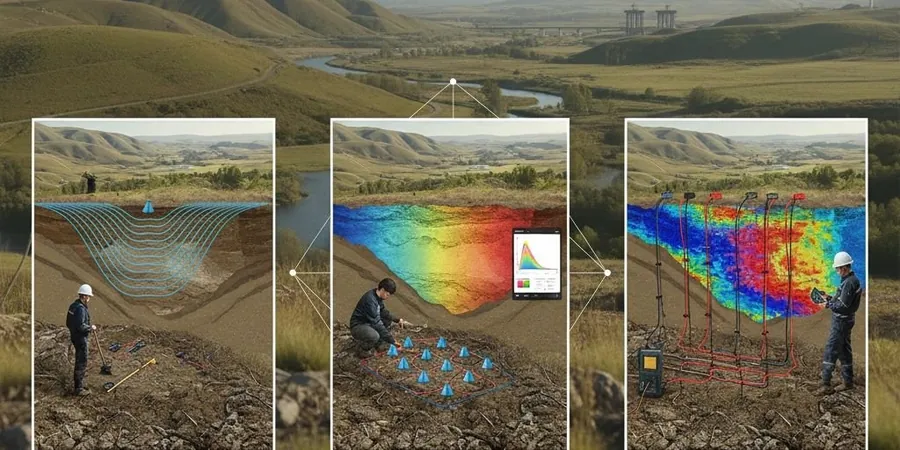
The Mississippi Embayment defines subsurface conditions across Memphis, with the Memphis Sand aquifer overlying thick sequences of Tertiary clays and the Paleozoic bedrock surface dropping to depths exceeding 800 feet in some areas. This sedimentary architecture creates distinct velocity contrasts that seismic tomography methods resolve with precision. The New Madrid seismic zone, centered roughly 40 miles northwest of the city, generates ongoing microseismicity that keeps geotechnical engineers attentive to site-specific shear-wave velocity profiles. Our laboratory team processes refraction and reflection data acquired across Shelby County, mapping top-of-bedrock elevation, identifying buried channel features, and determining Vs30 values needed for ASCE 7 site classification. Projects ranging from Memphis International Airport expansions to Mississippi River bridge foundations have relied on crosshole and downhole seismic tomography to characterize the loose alluvium and loess-covered terrace deposits typical of the Chickasaw Bluffs. When subsurface conditions demand high-resolution imaging beneath existing structures or in congested urban corridors, crosshole seismic surveys provide continuous velocity logs without the spatial averaging inherent in surface-based methods.

Velocity inversions in the Memphis Sand aquifer — where looser sands underlie stiffer overbank clays — demand tomographic inversion rather than simple layered interpretation.
Our service areas

Methodology and scope

Fieldwork in Memphis often reveals the loess mantle's influence on near-surface velocity gradients. This wind-deposited silt, 20 to 60 feet thick along the bluffs, exhibits P-wave velocities between 400 and 800 m/s in unsaturated conditions but drops sharply when moisture content rises after heavy rainfall. Crews working the Wolf River floodplain encounter saturated alluvium with velocities below 300 m/s, requiring careful geophone coupling and longer spread lengths to achieve adequate signal-to-noise ratios. Our data acquisition uses 48-channel seismographs with 4.5 Hz and 14 Hz geophones deployed in linear arrays of 110 to 230 feet, depending on target depth. Source energy comes from a 16-pound sledgehammer on steel plate for shallow refraction, supplemented by an accelerated weight drop when penetration beyond 100 feet is needed. Processing follows ASTM D5777 guidelines, applying first-break picking, delay-time analysis, and tomographic inversion using ray-tracing algorithms that handle the velocity inversions common in layered embayment sediments. Reflection processing incorporates CDP stacking, NMO correction, and migration routines tuned for the high-frequency content recoverable from shallow targets. For sites near the Mississippi River where fill and alluvium complicate interpretation, we combine seismic tomography with CPT soundings to calibrate velocity-to-strength correlations directly against measured tip resistance and sleeve friction.
Seismic Tomography (Refraction & Reflection) for Site Characterization in Memphis
Technical reference — Memphis

Local considerations

Downtown Memphis, built on Quaternary alluvium near the Mississippi River, presents fundamentally different seismic risk than the loess-bluff neighborhoods of East Memphis and Germantown. The alluvium downtown amplifies ground motion at periods of 0.5 to 1.5 seconds, while the stiff loess on the bluffs transmits energy efficiently with less amplification but greater short-period content. A site on Union Avenue might report Vs30 of 220 m/s (Site Class D), whereas a location four miles east near Poplar Avenue could exceed 350 m/s and qualify as Site Class C — a difference that changes the design spectral acceleration by 30 to 40 percent under ASCE 7-22. Neglecting these lateral variations, or assuming uniform stratigraphy across the city, introduces errors in seismic hazard assessment that propagate into foundation design and structural detailing. Reflection tomography identifies the depth to the top of the Memphis Sand and the underlying confining unit, both of which influence ground-motion amplification and liquefaction susceptibility in ways that standard borehole logging alone cannot capture.

Need a geotechnical assessment?

Reply within 24h.

Email: contact@geotechnical-engineering1.org

Applicable standards

ASTM D5777 — Standard Guide for Using the Seismic Refraction Method, ASTM D4428/D4428M — Standard Test Methods for Crosshole Seismic Testing, ASCE 7-22 — Minimum Design Loads (Site Classification based on Vs30), IBC 2021 — International Building Code (Seismic provisions referencing ASCE 7), ASTM D7400 — Standard Test Methods for Downhole Seismic Testing

Technical parameters

ParameterTypical value
P-wave velocity range (loess, unsaturated)400–800 m/s
P-wave velocity range (saturated alluvium, floodplain)200–400 m/s
Typical geophone spread length (refraction)110–230 ft (34–70 m)
Geophone frequency4.5 Hz / 14 Hz
Source type (shallow)16 lb sledgehammer on steel plate
Source type (deep penetration)Accelerated weight drop (AWD)
Recording channels48-channel seismograph
Standard referenceASTM D5777, ASTM D4428/D4428M

Frequently asked questions

How deep can seismic refraction tomography image in Memphis soils?

With a 230-foot geophone spread and an accelerated weight drop source, we routinely image to depths of 80 to 120 feet in the loess and alluvium of Shelby County. Greater penetration, down to 200 feet or more, is achievable by extending the spread length or using multiple shot points. Reflection tomography can reach the Paleozoic bedrock at 800-plus feet in the western part of the city, though resolution decreases with depth.

What does a seismic tomography survey cost in the Memphis area?

A typical seismic refraction or reflection survey in Memphis ranges from US$2,430 to US$5,480, depending on spread length, number of shot points, and whether crosshole or downhole methods are included. Projects requiring combined refraction and reflection processing, or surveys in congested urban areas with limited access, fall toward the upper end of that range.

How does the Mississippi Embayment geology affect seismic velocities?

The embayment stratigraphy — loess overlying Memphis Sand, which rests on the Flour Island Formation and Paleozoic bedrock — creates velocity inversions where higher-velocity sand is overlain by lower-velocity alluvium or loess. Standard refraction interpretation assuming increasing velocity with depth fails in these conditions, which is why we use ray-based tomographic inversion to correctly model the velocity structure.

What is the ASCE 7 site classification workflow using seismic methods?

We measure Vs30 — the average shear-wave velocity in the upper 30 meters — using MASW, downhole, or crosshole seismic methods. The resulting velocity places the site into one of ASCE 7-22's Site Classes (A through F). In Memphis, most sites fall into Class C or D, though sites near the Mississippi River with very soft alluvium may classify as Site Class E, requiring site-specific ground-motion analysis.

How does seismic tomography complement geotechnical drilling?

Seismic tomography provides continuous velocity profiles between and below boreholes, filling the spatial gaps that discrete sampling cannot address. When calibrated against SPT blow counts or CPT tip resistance from a few boreholes, the velocity model extrapolates soil and rock properties across the entire survey line, reducing the number of borings needed and improving the reliability of the ground model.

Location and service area

We serve projects across Memphis and its metropolitan area.

View larger map