GEOTECHNICAL ENGINEERING
MEMPHIS
HomeLaboratoryProctor test (Standard or Modified)

Proctor Test (Standard and Modified) in Memphis, TN

Technical studies that support your project.

LEARN MORE

Compaction control in Memphis isn't just about passing a field density test. It starts in the lab with a Proctor curve that actually represents the fill you're hauling in. ASTM D698 (Standard Proctor) and D1557 (Modified Proctor) define the moisture-density relationship, and the difference between them can shift a spec from 95% to 98% relative compaction overnight. On sites across Shelby County, from the loess-bluff line east of downtown to the Mississippi River alluvium west of I-240, the lab's choice of compaction energy has to match the structural load. When a retaining wall goes up behind a new warehouse in Frayser, we often see specs calling for Modified Proctor at 98% under the footing zone, while the general pad fill stays on a Standard curve. Pairing the lab work with a field sand cone density check closes the loop between the moisture target and what the roller actually achieves.

A Proctor curve built on the wrong compaction energy can make a passing fill look like it failed—or worse, pass fill that shouldn't have passed.
Our service areas

Methodology and scope

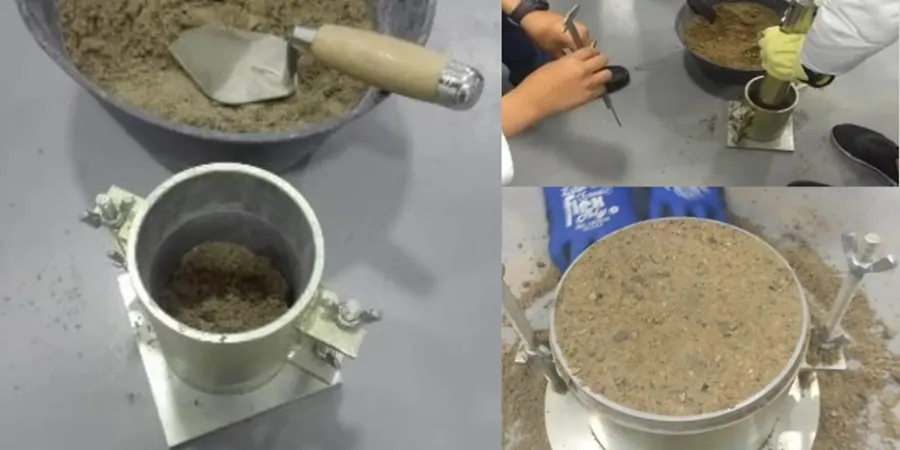
Memphis sits at roughly 337 feet above sea level on a bluff that drops sharply into the Mississippi floodplain, and that 100-foot elevation change means two sites a mile apart can be working with completely different borrow sources. One job might be cutting into the Peoria Loess and recompacting it as structural fill; another might be importing brown silt from a pit in West Memphis, Arkansas. The Proctor test defines the baseline. Standard Proctor uses a 5.5-lb hammer dropped 12 inches in a 4-inch mold, delivering 12,400 ft-lbf/ft³ of compactive effort. Modified Proctor jumps to a 10-lb hammer dropped 18 inches, hitting 56,000 ft-lbf/ft³—more than four times the energy. For Memphis DOT road subgrades or building pads under IBC Chapter 18, the Modified test is the default because it simulates the heavy compaction equipment common on commercial sites. The lab runs both single-point and five-point curves, reports optimum moisture and maximum dry density, and flags soils with gypsum or high organic content that can skew the curve. Every result gets tied to a USCS classification from ASTM D2487 so the field tech knows exactly what material the curve governs.
Proctor Test (Standard and Modified) in Memphis, TN
Technical reference — Memphis

Local considerations

Take two sites: one in the Poplar Corridor on Pleistocene loess, another down by the President's Island industrial area on Holocene alluvium near the Mississippi River. The loess can hit Proctor maximum dry densities around 105–110 pcf with optimum moisture near 14–16 percent and will lose strength fast if over-compacted wet of optimum. The river alluvium—more clay, more silt—might peak at 95 pcf with optimum moisture above 20 percent and need a completely different field target. Running a Modified Proctor on the loess without recognizing its collapse potential under wetting can produce a curve that looks great on paper but doesn't survive a Memphis summer thunderstorm. On the alluvium side, using Standard Proctor when the spec writer assumed Modified means the contractor is chasing a density they'll never hit with the equipment on site. The New Madrid seismic zone adds another layer: fill that goes through wet-dry cycles on a loose Proctor baseline can settle differentially during a moderate event, cracking slabs and pulling apart utility connections. The lab's job is to flag these mismatches before the first lift goes down.

Need a geotechnical assessment?

Reply within 24h.

Email: contact@geotechnical-engineering1.org

Explanatory video

Applicable standards

ASTM D698-12, ASTM D1557-12e1, ASTM D2487-17, IBC 2018 (Chapter 18)

Technical parameters

ParameterTypical value
Test standardASTM D698 (Standard), ASTM D1557 (Modified)
Hammer mass5.5 lb (Standard) / 10 lb (Modified)
Drop height12 in (Standard) / 18 in (Modified)
Mold volume1/30 ft³ (4-inch mold)
Compactive effort12,400 ft-lbf/ft³ (Standard) / 56,000 ft-lbf/ft³ (Modified)
Typical moisture range8%–25% depending on soil plasticity
Method optionsA, B, C per particle size (up to 3/4 in sieve)
Reported valuesOptimum moisture content, Maximum dry density (pcf)

Frequently asked questions

How much does a Proctor test cost in Memphis?

A Standard or Modified Proctor (five-point curve) typically runs between US$90 and US$240 depending on the method and whether we're pulling from an existing family of curves or starting fresh. One-point verifications land at the lower end of that range. We'll give you a firm number once we know the soil classification and project spec.

Which Proctor test does IBC require for building pads in Memphis?

IBC Chapter 18 references ASTM D1557 (Modified Proctor) for structural fill under footings and slabs unless the geotechnical report specifies otherwise. Most Memphis commercial projects default to Modified Proctor at 95% or 98% relative compaction, but residential additions on loess may use Standard Proctor if the design load is light.

How long does it take to get results back?

Standard turnaround is 48 hours from sample drop-off. We run the moisture content in our lab ovens overnight, compact the points the next morning, and have the curve plotted by end of day. Rush 24-hour turnaround is available for crews waiting on a density target.

Can you run a Proctor on fill that already has gravel or rock fragments?

Yes. ASTM D698 and D1557 both include Method B (material passing the 3/8-inch sieve) and Method C (passing 3/4-inch). If the fill has oversize particles beyond 3/4 inch, we apply rock correction per ASTM D4718 to adjust the curve so it represents the total material, not just the fines.

Location and service area

We serve projects across Memphis and its metropolitan area.

View larger map